Calculating Heart Rate from Irregular ECG Tracings: Digital vs. Manual Methods

Chief Executive Officer
The challenge of irregular rhythms
Calculating an accurate heart rate from a standard ECG tracing is straightforward when the rhythm is regular. You count the large squares between R-waves and divide 300 by that number, or use the 1500 method for higher precision. But when the rhythm is irregular—common in Atrial Fibrillation (AFib), multifocal atrial tachycardia, or with frequent premature complexes—these "shortcut" methods fail to provide a clinically meaningful number.
In clinical practice, the goal is often to find the average heart rate over a period of time, as well as the range (the fastest and slowest beats). Relying on a single interval in an irregular rhythm can lead to dangerous over- or under-estimations of a patient's hemodynamic status.
Traditionally, clinicians use the 6-second strip method: count the number of R-waves in a 6-second window and multiply by 10. While functional, it is prone to error if your "window" is slightly off, if the strip scan is distorted, or if the patient is experiencing a transient burst of tachycardia that doesn't fit neatly into that arbitrary 6-second slice.
Manual methods: The 6-second rule
To calculate heart rate manually on a paper strip:
- Identify a 6-second section (30 large squares at 25mm/s).
- Count the number of QRS complexes within that period.
- Multiply by 10 for the beats per minute (BPM).
This works, but what if you're looking at a scanned PDF on a 4K monitor? The physical size of those "large squares" no longer matches your real-world ruler. This is where digital ECG measurement becomes essential.
Digital methods: Speed and precision
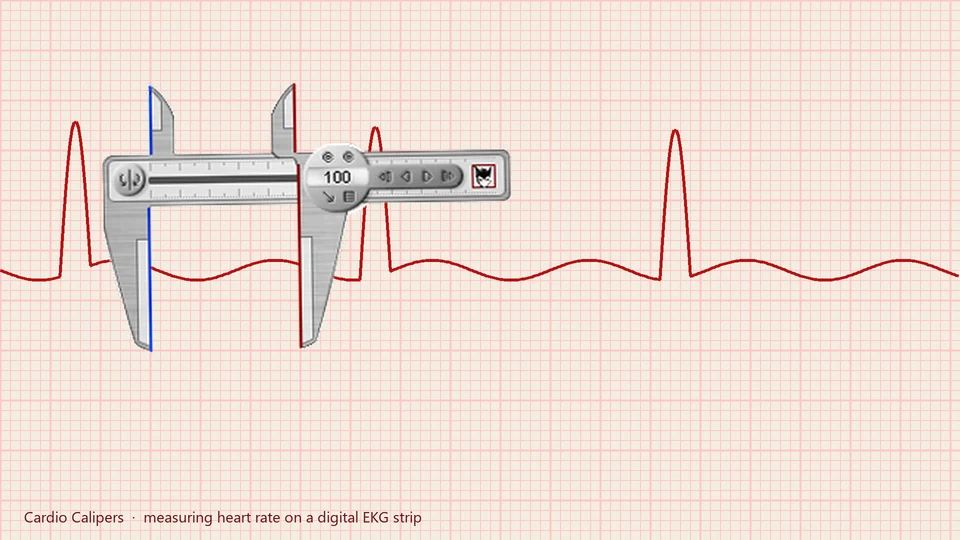
Using Cardio Calipers, you can calculate heart rate instantly without counting squares or squinting at blurry PDF grid lines.
- Instant BPM: Switch the Caliper units to 'Heart Rate'. Align the jaws between two consecutive R-waves. The readout shows the BPM immediately based on that specific interval. This is perfect for identifying the "worst-case" speeds in an irregular rhythm.
- Averaging Irregular Rhythms: For irregular tracings, measure several different R-R intervals across the strip to find the range and average. Because the calipers float over your viewer, you can move them rapidly across the screen, sampling 5 or 10 intervals in seconds to get a true representation of the ventricular response.
- Eliminating Paper Speed Math: Cardio Calipers handle the math for 25mm/s or 50mm/s paper speeds automatically. You no longer have to worry if the scanned image was resized or if your PDF viewer is at 100% or 150% zoom.
- Calibration for Screen Scaling: The key is calibrating to the paper speed. Simply align the calipers with a known 20mm (four large squares) or a 1-second reference on the grid once, and every measurement thereafter is mathematically accurate regardless of your screen's resolution or zoom level.
Why digital measurement wins for Telehealth
As more cardiology reviews move to telehealth and remote monitoring, clinicians are rarely holding physical paper strips. They are looking at screenshots from EMRs or mobile heart monitors. Cardio Calipers bridge the gap by providing a professional medical tool that sits on top of any Windows software.
Read more about our medical solutions on the Cardio Calipers page .
Try Cardio Calipers
Download the free trial for Windows 10 and 11, or buy a license.
