Physical vs. Digital EKG Calipers: Why Telehealth Techs Are Switching

Chief Executive Officer
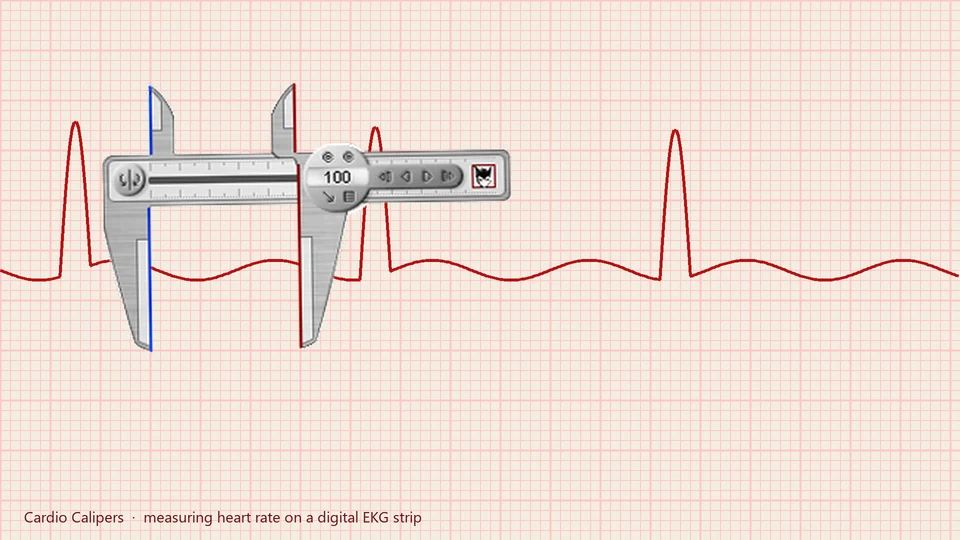
The end of the brass caliper?
For decades, the standard tool for cardiology students, telemetry nurses, and MDs was the physical brass caliper. You'd hold it up to a paper ECG strip, walk the points along the grid, and hope your hand didn't slip while you manually calculated intervals like the PR or QTc. But as the medical world has pivoted from paper charts to digital pixels, the physical tool has transitioned from a trusted companion to a liability in a modern clinical workflow.
The shift isn't just about convenience; it's about the fundamental mechanics of measurement. If you're working in telehealth, remote patient monitoring, or reviewing scans in a hospital EMR, you're not looking at a standard 1:1 paper printout. You're looking at a 27-inch monitor, a laptop, or perhaps even a tablet.
Holding a physical ruler against a glass screen is inherently flawed. Parallax error (the angle of your eye relative to the screen) can throw off your measurements by several crucial pixels. Furthermore, physical calipers are awkward to handle against vertical monitors and risk scratching expensive medical-grade hardware.
Why digital is safer and faster
- Resolution Independence: A physical ruler only measures centimeters or inches. Cardio Calipers calibrate to the specific paper grid on your screen. This means you get milliseconds (ms) and beats per minute (BPM) directly from the readout, regardless of whether the image is zoomed in to 50% or 200%.
- Digital Record Keeping: In a clinical audit or for educational purposes, you can take a screenshot of your digital measurement "walking" the rhythm. This creates a permanent, visible audit trail of your interpretation that can be attached to a patient's chart or shared with a colleague for a second opinion.
- Sanitation & Hygiene: In a post-COVID clinical environment, physical tools are another surface to sanitize. Digital calipers stay entirely within the software environment, eliminating one more vector for cross-contamination in busy nursing stations.
- Reduced Ergonomic Fatigue: Walking manual calipers across dozens of rhythm strips is a recipe for hand strain and repetitive motion injury. On-screen calipers use familiar mouse and keyboard shortcuts. Our software lets you "nudge" measurements one pixel at a time using keyboard arrows, ensuring ultimate precision without the steady-hand requirement of brass tools.
- Automatic Calculation: Modern digital calipers don't just measure distance; they do the math. From Bazett's formula for QTc to instant heart rate conversions, the software eliminates the mental arithmetic that often leads to errors during long shifts.
The "Hospital Proof" tool
One reason telehealth teams prefer our solution is that it doesn't require a complex EMR integration. Cardio Calipers are a "floating overlay"—they sit on top of any hospital image viewer, Citrix session, or web-based portal.
If your facility is still using physical tools for digital strips, it's time to upgrade.
Download the free trial on the Cardio Calipers page .
Try Cardio Calipers
Download the free trial for Windows 10 and 11, or buy a license.
